Posts

Showing posts with the label ordinal numbers to order travelling things or dates

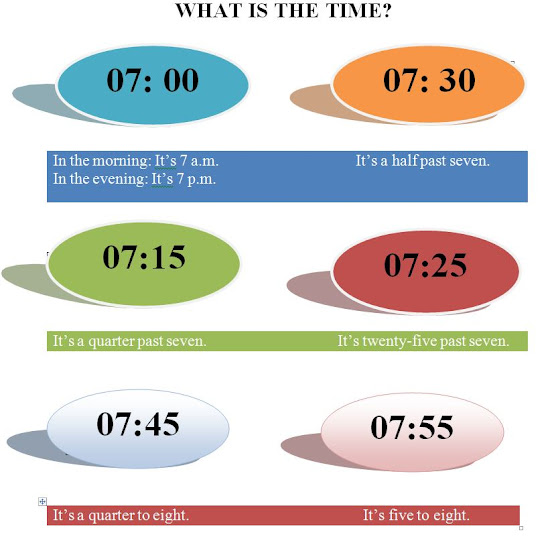
SPECIAL WAYS TO SAY THE TIME
Image
PRACTISE SAYING THE TIME Here are a few tips for practicing saying the time in English: Start with the basics: Begin by learning how to say the hours and minutes in English. For example, "one o'clock" is "one," "two o'clock" is "two," and so on. For minutes, "fifteen" is "fifteen," "thirty" is "thirty," and so on. Practice using "a.m." and "p.m.": In English, "a.m." stands for "ante meridiem," which means "before noon," and "p.m." stands for "post meridiem," which means "after noon." Practice using these abbreviations to indicate whether the time is in the morning or the afternoon. Use "half past" to indicate 30 minutes past the hour: To indicate 30 minutes past the hour, you can use the phrase "half past," followed by the hour. For example, "half past two" is "2:30," and ...

ORDINAL NUMBERS TO ORDER BETTER YOUR TRAVELLING THINGS AND GIVE THE DATES

Image
ORDINAL NUMBERS TO ORDER BETTER YOUR TRAVELLING THINGS AND GIVE THE DATES Ordinal numbers, or "ordering numbers," are used to indicate position or order in a series. They can be especially useful when traveling for the following reasons: To understand dates: Ordinal numbers are often used to express the day of the month, such as "first," "second," "third," etc. Knowing ordinal numbers can help you understand dates and make travel arrangements. To understand directions: Ordinal numbers are also used to give directions, such as "turn left at the third intersection." Knowing ordinal numbers can help you navigate unfamiliar places and follow directions more easily. To understand rankings and ratings: Ordinal numbers are often used to indicate rankings or ratings, such as the "top 10" or the "best restaurants." Knowing ordinal numbers can help you make informed decisions about activities and attractions when traveling. T...